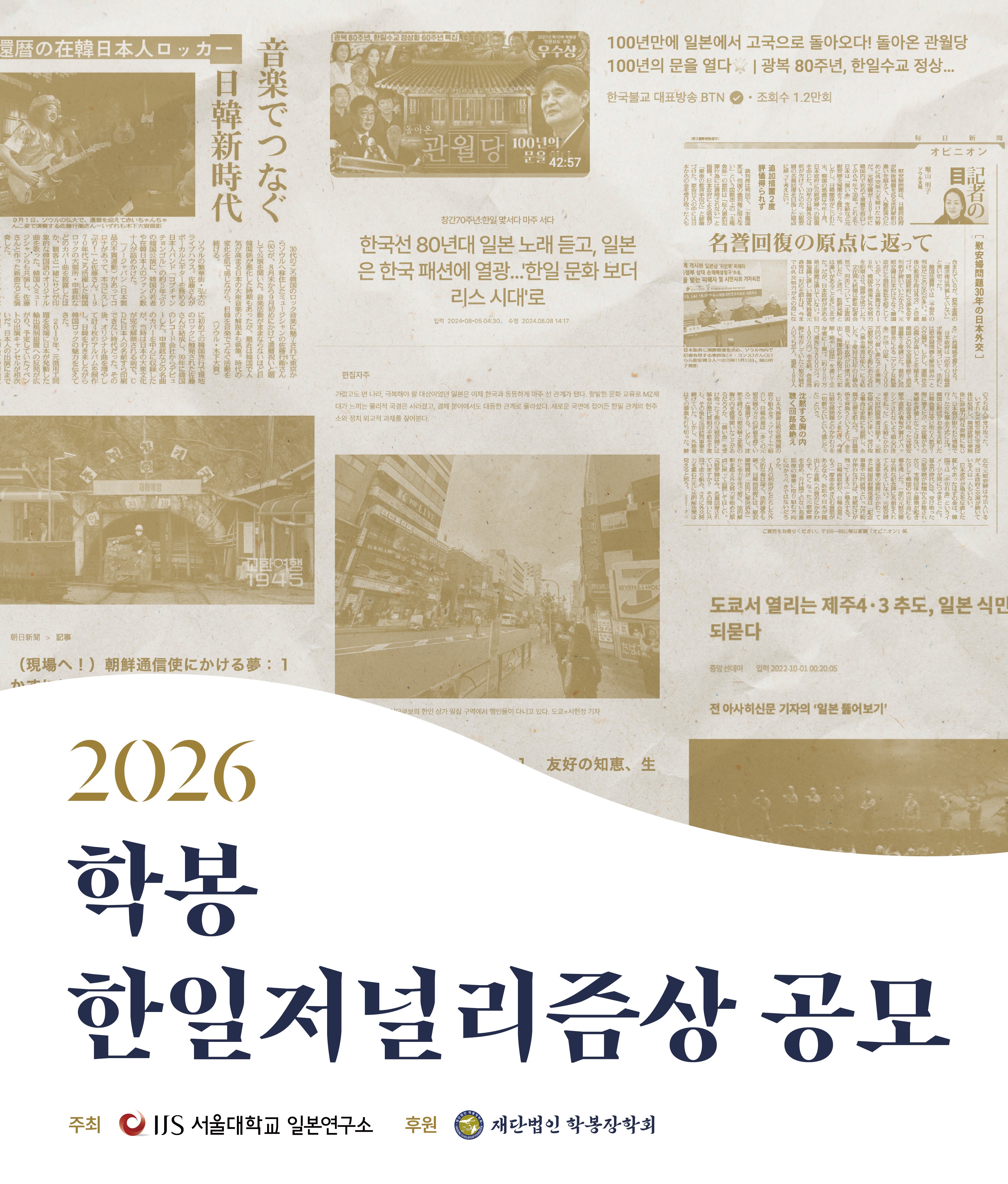
Purpose of the Hakbong Korea-Japan Journalism Award
Korea-Japan relations is now moving beyond the stage of managing past conflicts and standing at a turning point as a community of shared destiny to jointly overcome the “contemporary crises” that both countries face.
Geopolitical crises, demographic changes caused by low birth rates and population aging, the crisis of local extinction, gender and LGBTQ issues, multicultural coexistence and an inclusive society, deepening economic and social polarization, the climate crisis and disaster response, and the existential crises of the age of digital transformation and AI are all challenges of our time that cannot be resolved through the efforts of one country alone. At this critical juncture, the role of the media as a “public sphere” that seeks social solutions and gathers the wisdom of both countries has become more important than ever.
Since the modern period, Japan has had a profound influence on Korean society as a whole, and the two countries have grown with each other as mirrors. At times, mistrust and antagonism have come to the fore, but on the back stage there has always been intense exchange through mutual reassessment and fresh discovery. Now, we must redefine Korea-Japan relations not simply as “diplomatic relations,” but as a “partnership” between countries undergoing similar social pains. The media must become both a mirror that reflects the collective thinking of the two countries and an “intellectual bridge” that spreads awareness of problems and shares clues to their solutions across borders.
At this time, the true value of the media lies not in the simple delivery of information, but in building a “public sphere” in which citizens can think and act together. Only when we draw out “practical solidarity” to solve common difficulties on the basis of “respect” that recognizes each other’s differences, we can invite a brighter future.
The Hakbong Scholarship Foundation has operated the Hakbong Award since 2015, carrying on the philosophy of the late Hakbong Lee Ki-hak (1928–2012), a Zainichi Korean businessman. The “Research Division” project, which had been led by Seoul National University School of Law, fulfilled its role by presenting intellectual solutions to fundamental problems in our society, and now remains as a valuable part of the history of the Hakbong Award.
The Hakbong Award is now beginning its second stage together with the Institute for Japanese Studies at Seoul National University by elevating the “Journalism Division” to its core project. This award, which has continued since 2021, now seeks to go beyond a simple award program and become a foundation for “journalism in action” that presents models of cooperation between Korea and Japan. With the belief that untangling the knots and designing future together is the most urgent task of our time, the Hakbong Korea-Japan Journalism Award will discover and support outstanding reportings that lead the coexistence and development of the two countries.
| Korea-Japan Relations from Conflict to Coexistence |
Grand Prize |
KRW 20 million |
1 winner |
| Excellence Award |
KRW 10 million |
Several winners |
| Encouragement Award |
KRW 5 million |
Several winners |