
The Institute for Japanese Studies invites Japan specialists from Korea and Japan, as well as Europe and the United States, to hold seminars in Japanese, Korean, and English on diverse topics across Japanese politics, economy, society, culture, and the arts.
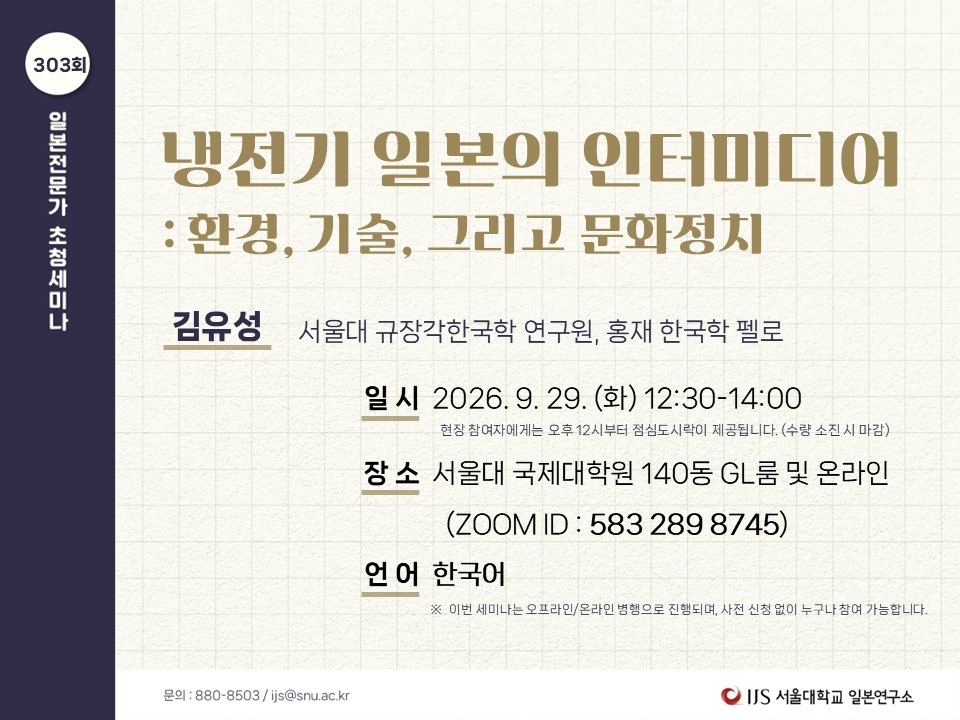
The 303rd Japan Specialist Seminar will be held under the theme “Intermedia in Cold War Japan: Environment, Technology, and Cultural Politics.” We ask for the participation of all who are interested.
This seminar will be held in hybrid format, both in person and online. Anyone may attend on site without prior registration, and boxed lunches will be provided from 12:00 p.m. and will be available while supplies last.
Date/Time: September 29 (Tue), 2026, 12:00–14:00 (lecture begins at 12:30)
Venue: GL Room, Building 140, GSIS, SNU / Online via ZOOM (ZOOM ID: 583 289 8745; Link: https://snu-ac-kr.zoom.us/j/5832898745)
Language: Korean
Speaker: KIM Yuseong (Hong Jae Korean Studies Fellow, Kyujanggak Institute for Korean Studies, Seoul National University)
Title: Intermedia in Cold War Japan: Environment, Technology, and Cultural Politics
In 1960s Japan, “intermedia” developed as an experiment that crossed the boundaries of artistic genres and newly connected the senses of audiences with everyday spaces. Focusing on the From Space to Environment exhibition (1966), the activities of experimental filmmaker IIMURA Takahiko (飯村隆彦), and the “Crosstalk Intermedia” event (1969), the speaker examines the emergence of the concept of “environment” and how electronic technologies in everyday life became intertwined with artistic practices.
In particular, the speaker analyzes the geopolitical factors that enabled artistic exchanges between Japan and the United States during the Cold War through cultural diplomacy, corporate sponsorship, and technological infrastructure, and examines the process through which these exchanges led to Expo 1970 Osaka. Through this analysis, the speaker seeks to reveal the possibilities and tensions of intermedia practices in Japan, which pursued sensory liberation and communal communication while becoming entangled with technological visions of the future presented by the state and corporations.
Inquiries: Administrative Office, Institute for Japanese Studies (02-880-8503 / ijs@snu.ac.kr)


