
The Institute for Japanese Studies invites Japan specialists from Korea and Japan, as well as Europe and the United States, to hold seminars in Japanese, Korean, and English on diverse topics across Japanese politics, economy, society, culture, and the arts.
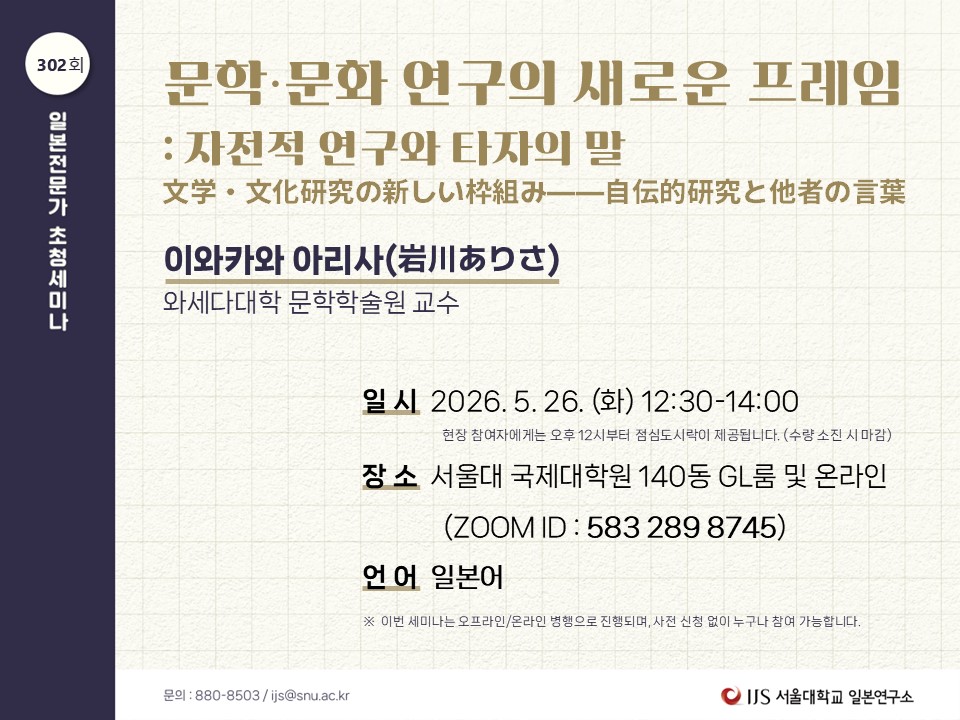
The 302nd Japan Specialist Seminar will be held under the theme “A New Framework for Literary and Cultural Studies: Autobiographical Research and the Words of Others.” We ask for the participation of all who are interested.
This seminar will be held in hybrid format, both in person and online. Anyone may attend on site without prior registration, and boxed lunches will be provided from 12:00 p.m. (available while supplies last).
Date/Time: May 26 (Tue), 2026, 12:00–14:00 (lecture begins at 12:30)
Venue: GL Room, Building 140, GSIS, SNU / Online via ZOOM
ZOOM ID: 583 289 8745 (Link: https://snu-ac-kr.zoom.us/j/5832898745)
Language: Japanese
Speaker: IWAKAWA Arisa (岩川ありさ, Professor, Faculty of Letters, Arts and Sciences, Waseda University)
Title: A New Framework for Literary and Cultural Studies - Autobiographical Research and the Words of Others(文学・文化研究の新しい枠組み―自伝的研究と他者の言葉)
Feminist criticism and queer criticism ask how frameworks of thought have been formed and how they operate, producing ways of making value judgments and interpretations concerning literature and culture. The current framework of literary and cultural studies may be said to have been formed by androcentrism, presupposing binary gender; regarding self-evident cisgender existence, in which one lives according to the gender assigned at birth; treating values such as heterosexuality, reproduction, romance, and having a partner as natural. The speaker considers a new framework for literary and cultural studies by connecting autobiographical research with feminist criticism and queer criticism. In doing so, using the word “that” (アレ), which appears in the novels of OE Kenzaburo, as a clue, the speaker examines what it means to read the words of others from the perspective of care, and what it means for resonance with one’s own life to arise from that.


