
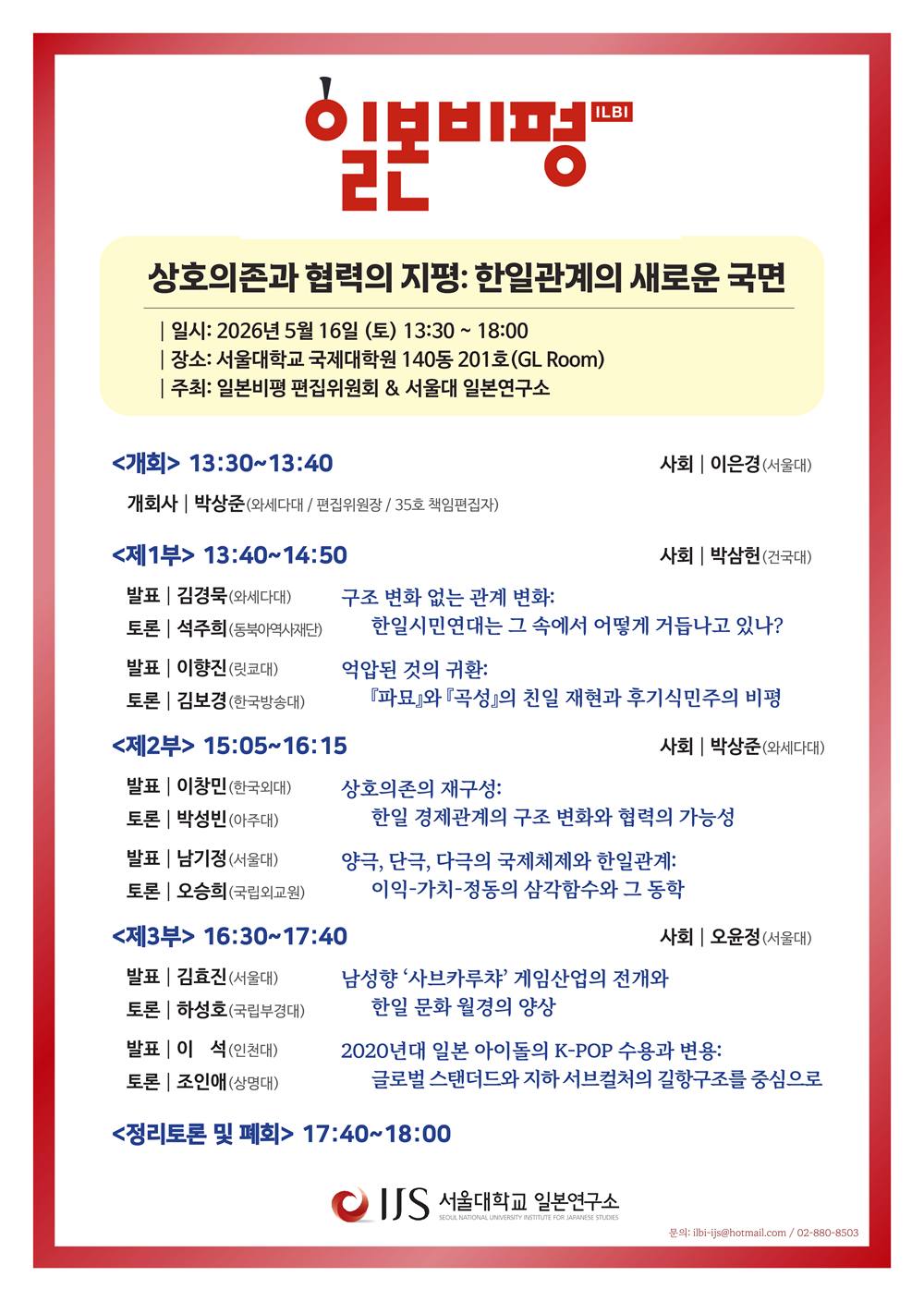
KJJS Academic Conference
Theme: "The Horizon of Interdependence and Cooperation: A New Phase in Korea-Japan Relations"
Date/Time: May 16 (Sat), 2026, 13:30–18:00
Venue: GL Room, Building 140, GSIS, SNU
Zoom: https://snu-ac-kr.zoom.us/j/5832898745 (Meeting ID: 583 289 8745)
Host: KJJS Editorial Board & Institute for Japanese Studies, Seoul National University
The Editorial Board of Korean Journal of Japanese Studies has selected “The Horizon of Interdependence and Cooperation: A New Phase in Korea-Japan Relations” (tentative title / editor in charge: BAAK Saang Joon) as the theme for the special feature of volume 35, scheduled for publication on August 15, 2026.
Around the 60th anniversary of diplomatic normalization in 2025, many changes have taken place in Korea-Japan relations. Korea and Japan both face the common problems of aging and population decline; Korean and Japanese companies are struggling with the intensifying conflict between the United States and China; the governments of both countries share a similar predicament in responding to investment pressure from the Trump administration; the awareness of Japan’s younger generation is changing as they now see Korea as an advanced country on a par with Japan; Korea’s younger generation enjoys and consumes Japanese culture and travel regardless of conflicts surrounding history and politics.
Political circles in Korea and Japan appear to be cautious about causing unnecessary confrontation and friction in politics and diplomacy. Discussions on collaboration between Korean and Japanese companies are more active than ever. Young people in Korea and Japan enjoy games developed by companies in each other’s country. There are increasing numbers of dramas featuring actors from both Korea and Japan and performances in which Korean and Japanese musicians collaborate. Have Korea-Japan relations entered a qualitatively new phase different from the past? Has there been any change in the gap between Korean and Japanese historical perceptions? Has an era of cooperation arrived in place of conflict? Or, under a complex international situation, have long-standing conflicts merely sunk temporarily below the surface?
Now that a horizon of interdependence and cooperation is visible, we seek to look back on the changes in Korea-Japan relations over the 60 years since diplomatic normalization and to examine what changes have taken place in politics, economy, culture, and historical perception around the 60th anniversary of diplomatic normalization, as well as the current contents of conflict and cooperation.
To help this project bear better fruit, we are holding the following academic conference as an interim report on six papers. Anyone interested is welcome to participate freely, and we also ask you to look forward to the results being published in Korean Journal of Japanese Studies in August 2026.
Program
Opening Ceremony: 13:30–13:40
Moderator: LEE Eun-gyung (Seoul National University)
Opening Remarks: BAAK Saang Joon (Waseda University / Chair of the Editorial Board / Editor in Charge of volume 35)
Session 1: 13:40–14:50
Moderator: PARK Sam-hun (Konkuk University)
KIM Kyungmook (Waseda University), “Relationship Change without Structural Change: How Is Korea-Japan Civic Solidarity Being Reborn within It?”
Discussant: SUK Ju Hee (Northeast Asian History Foundation)
LEE Hyangjin (Rikkyo University), “The Return of the Repressed: Pro-Japanese Representations in Exhuma and The Wailing and Postcolonial Critique”
Discussant: KIM Bo-Kyung (Korea National Open University)
Session 2: 15:05–16:15
Moderator: BAAK Saang Joon (Waseda University)
LEE Changmin (Hankuk University of Foreign Studies), “The Reconfiguration of Interdependence: Structural Changes in Korea-Japan Economic Relations and the Possibility of Cooperation”
Discussant: PARK Sung-bin (Ajou University)
NAM Kijeong (Seoul National University), “Bipolar, Unipolar, and Multipolar International Systems and Korea-Japan Relations: The Triangle of Interest–Value–Affect and Its Dynamics”
Discussant: OH Seung-hee (Korea National Diplomatic Academy)
Session 3: 16:30–17:40
Moderator: OH Younjung (Seoul National University)
KIM Hyojin (Seoul National University), “The Development of the Male-Oriented ‘Sabukarucha’ Game Industry and Aspects of Korea-Japan Cultural Border-Crossing”
Discussant: HA Seong-ho (Pukyong National University)
LEE Seok (Incheon National University), “The Acceptance and Transformation of K-POP by Japanese Idols in the 2020s: Focusing on the Antagonistic Structure between Global Standards and Underground Subculture”
Discussant: CHO In-Yae (Sangmyung University)
Wrap-Up Session and Closing Ceremony: 17:40–18:00


