
The Institute for Japanese Studies (IJS) has been hosting a series of talks covering Japanese politics, economy, society, culture, and the arts. With experts from Korea, Japan, Europe, and the U.S., the seminars are delivered in multiple languages including Japanese, Korean, and English.
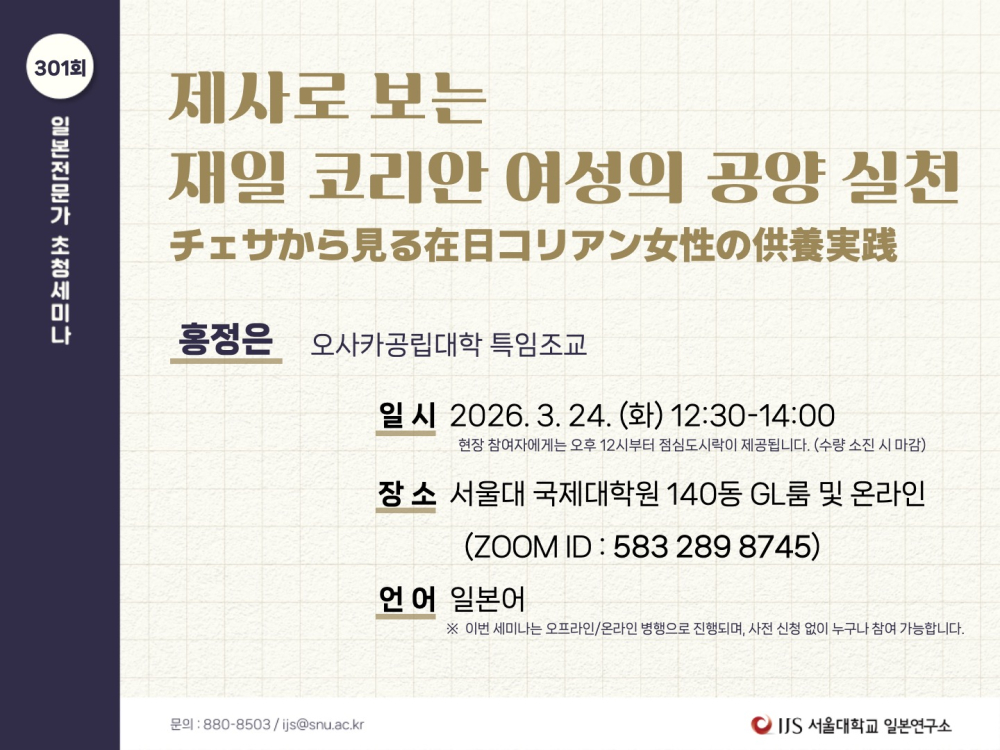
We are pleased to host the 300th lecture as part of the Japan Specialist Seminars, titled “Commemorative Practices of Zainichi Korean Women in Jesa.”
This seminar will be held in a hybrid format. Anyone interested is welcome to attend without prior registration. Lunch boxes will be provided starting at 12:00 p.m. (Please note that availability may be limited.)
Date: March 24, 2026 (Tuesday) 12:00-14:00 (The lecture will start from 12:30).
Venue: GL Room, GSIS (Bldg. 140) and online via ZOOM
- Zoom ID : 583 289 8745
- Zoom Link : https://snu-ac-kr.zoom.us/j/5832898745
Lecturer: HONG Jungeun (Project Assistant Professor, Osaka Metropolitan University)
Title: Commemorative Practices of Zainichi Korean Women in Jesa
Jesa, a Confucian ancestral rite (法事) originating on the Korean Peninsula, is widely known as a form of ancestor veneration. Within Zainichi Korean communities in Japan, it has been maintained as an everyday commemorative practice passed down from the first generation of migrants. As generational change has progressed within the Zainichi Korean community, however, this practice has undergone certain transformations.
The first generation, who largely maintained their original language and customs, tended to follow ritual practices from the Korean Peninsula faithfully, including not only jesa ceremonies that reach back to three generations of ancestors but also funeral and burial practices conducted according to traditional Korean rites. By contrast, among later generations born and raised in Japan, the ritual has increasingly been simplified. For these descendants, jesa tends to function less as a strict act of ancestral veneration and more as an opportunity to reflect on their roots and as a social setting where family members and relatives gather and interact.
Several factors help explain these changes. First, because the rituals are performed away from the Korean Peninsula, the strictness of the original ceremonial form has been somewhat relaxed. Second, the sense of connection to ancestors and to the ancestral homeland has relatively weakened over time. Third, there has been diversification in the roles and practices of women who are responsible for preparing the jesa.
Drawing on insights from transnational migration studies, this seminar analyzes the concrete commemorative practices of Zainichi Korean women living in Osaka Prefecture from an intersectional perspective that considers nationality, gender, ethnicity, generation, and religious belief.
Language : Japanese
Inquiry : SNU-IJS (880-8503 / ijs@snu.ac.kr)


