Discussion
On March 26, 2026, the 7th Korea-Japan Future Seminar was held online via Zoom, with more than 60 participants. FUKUNAGA Genya, Project Professor of the Diversity & Inclusion Division, College of Arts and Sciences, the University of Tokyo, delivered a presentation titled "The Transnational Circulation of Anti-Transgender Hatred in East Asia," followed by a Q&A session moderated by Professor KIM Hyojin.
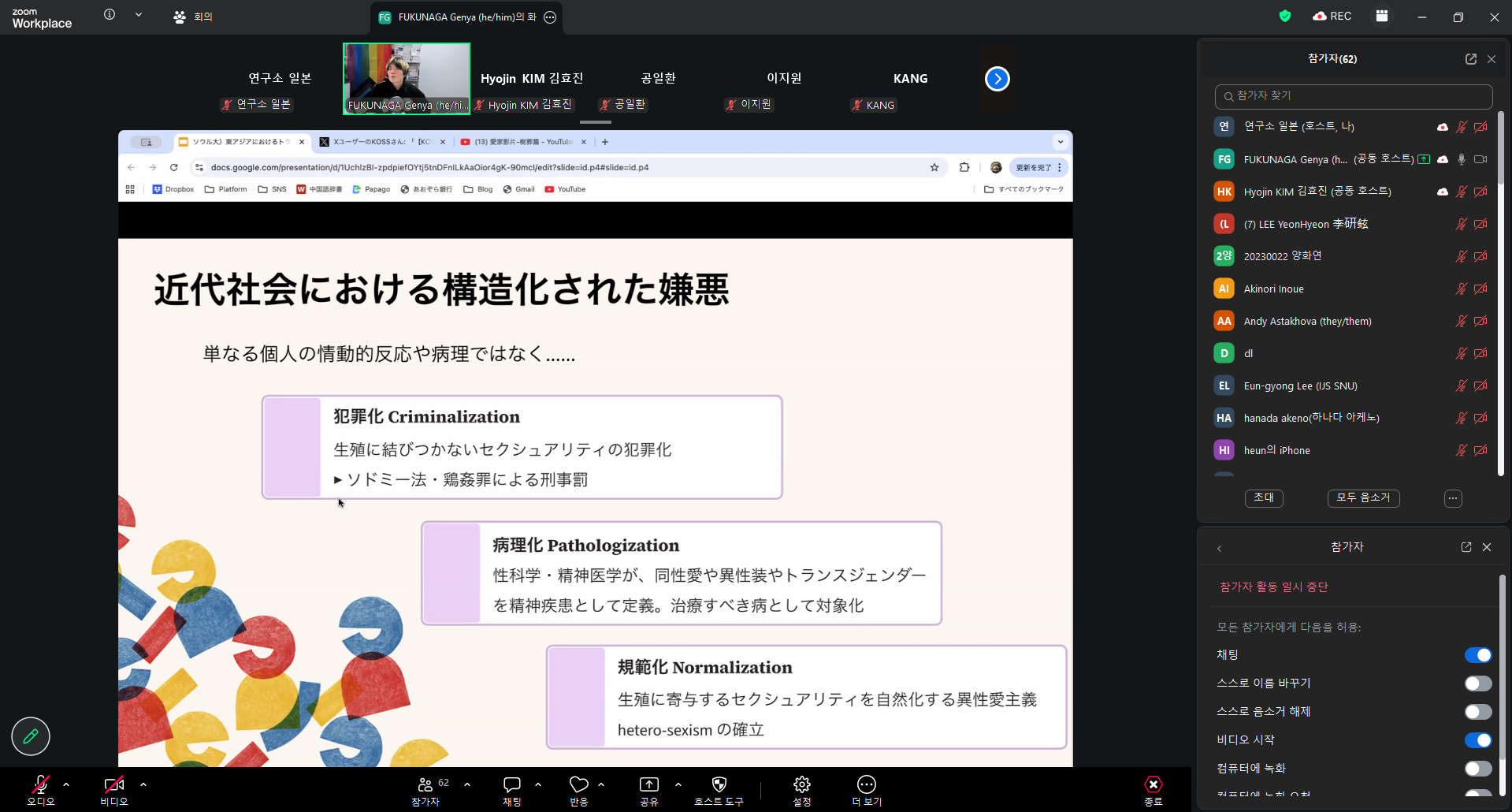
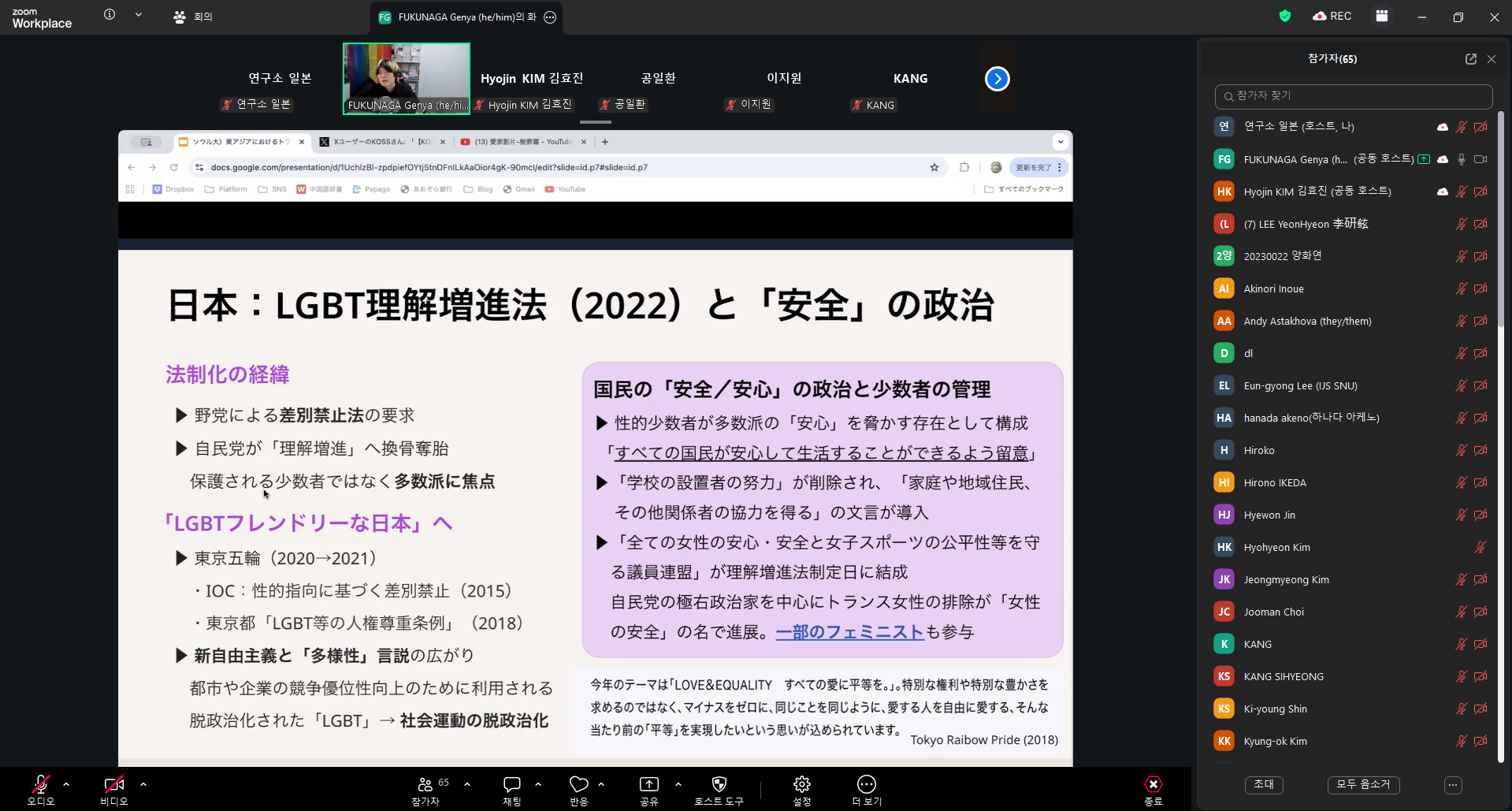
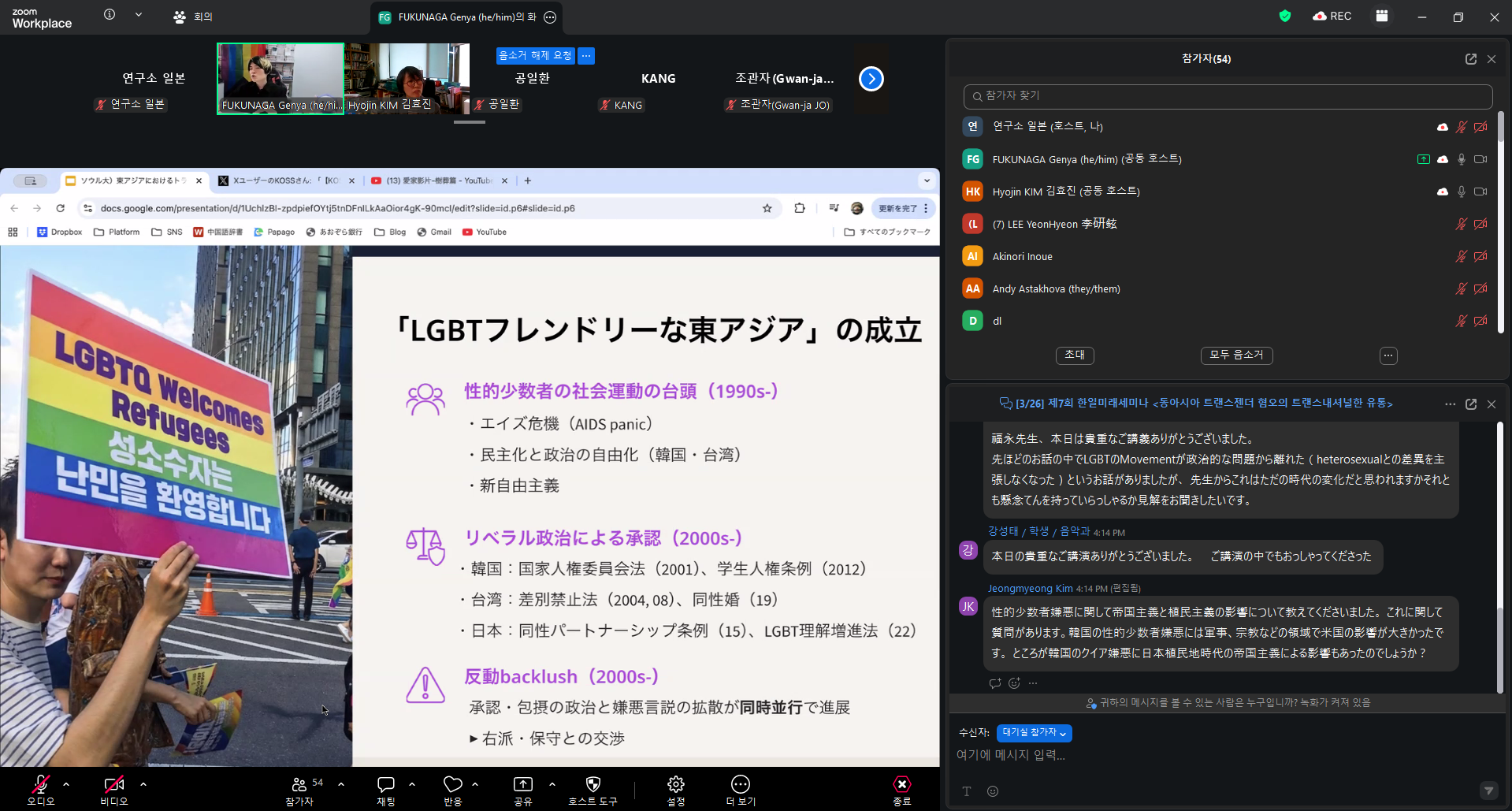
Professor FUKUNAGA explained that since the 1990s, East Asian countries including Japan, Korea, and Taiwan have seen institutional recognition of sexual minorities and a growing spread of hatred as backlash. Asking why this hatred has become widespread, the presenter examined actors, platforms, motives, and forces behind its circulation. Professor FUKUNAGA argued that Korea functions as a nodal point, and stressed that structured hatred should not be understood merely as an affective response, but through the three dimensions of criminalization, pathologization, and normalization. From this perspective, democratization in Korea and Taiwan and the rise of neoliberalism helped bring sexual minority movements to the forefront in the 1990s, and liberal political forces in Korea, Taiwan, and Japan moved toward institutional inclusion and recognition in the 2000s. At the same time, hate speech emerged across multiple countries as backlash. The presenter concluded by suggesting that networks of the religious right and the translation and circulation of hateful discourse through conservative media are routes for the spread of hatred across East Asia.
During the Q&A, Professor FUKUNAGA noted that anti-gender language from the UK and US is entering Japan, and that young Japanese feminists interested in Korean feminism are learning such language through platforms like X. The presenter also explained that this research was motivated by observing similar patterns of anti-gender discourse spreading in China.